
Daybreak
Chiyaba Phase 144MWac
Chiyaba, Kafue District, Lusaka Province
10 MW / 20 MWh LFP battery (co-located, 2-hour)
10 MW / 20 MWh LFP battery (co-located, 2-hour)
Funder discussions

Mpishi Energy is developing utility-scale solar and battery storage in Zambia: the 100 MW Chiyaba site is in advanced development and in funder discussions, with a further 375 MW in the pipeline. Each project is being structured in its own ring-fenced project company, built to the standards lenders expect.
Mpishi Energy is the developer and sponsor. Every project sits in its own special-purpose vehicle with its own land, licences, contracts and accounts, so lenders can size against the asset in front of them, and equity can enter at the level that suits them.
Daybreak (44 MW) and Zenith (56 MW) on the Chiyaba site. Implementation Agreement signed; ZEMA-approved ESIA, ZESCO grid connection agreement and ERB construction permit for Phase 1 in place. Phase 2 export follows a Mpishi-funded evacuation upgrade.
Four sites across Southern, North-Western and Lusaka provinces, selected for grid headroom, offtake depth and irradiation.
Lusaka-based, locally led, with three decades of project development and finance experience behind the platform.
Heads of terms agreed for a 25-year USD-indexed PPA with a premium offtaker, the revenue line lenders size against.
Registration as a Southern African Power Pool (SAPP) supplier and trader is under way, opening regional offtake beyond Zambia.
Co-located LFP batteries firm daytime output and shift energy into the evening peak, providing the capacity Zambia's hydro-heavy grid is short of.
Six plants, named for the arc of a solar day, each a standalone company. Two are in advanced development and in discussion with funders; four are in the pipeline.
Across most of Zambia, each kilowatt of solar capacity produces more than 1,500 kWh a year, and about 1,823 kWh at our Chiyaba site (P50), with a long, clear dry season. Our sites sit inside that resource, close to the grid.
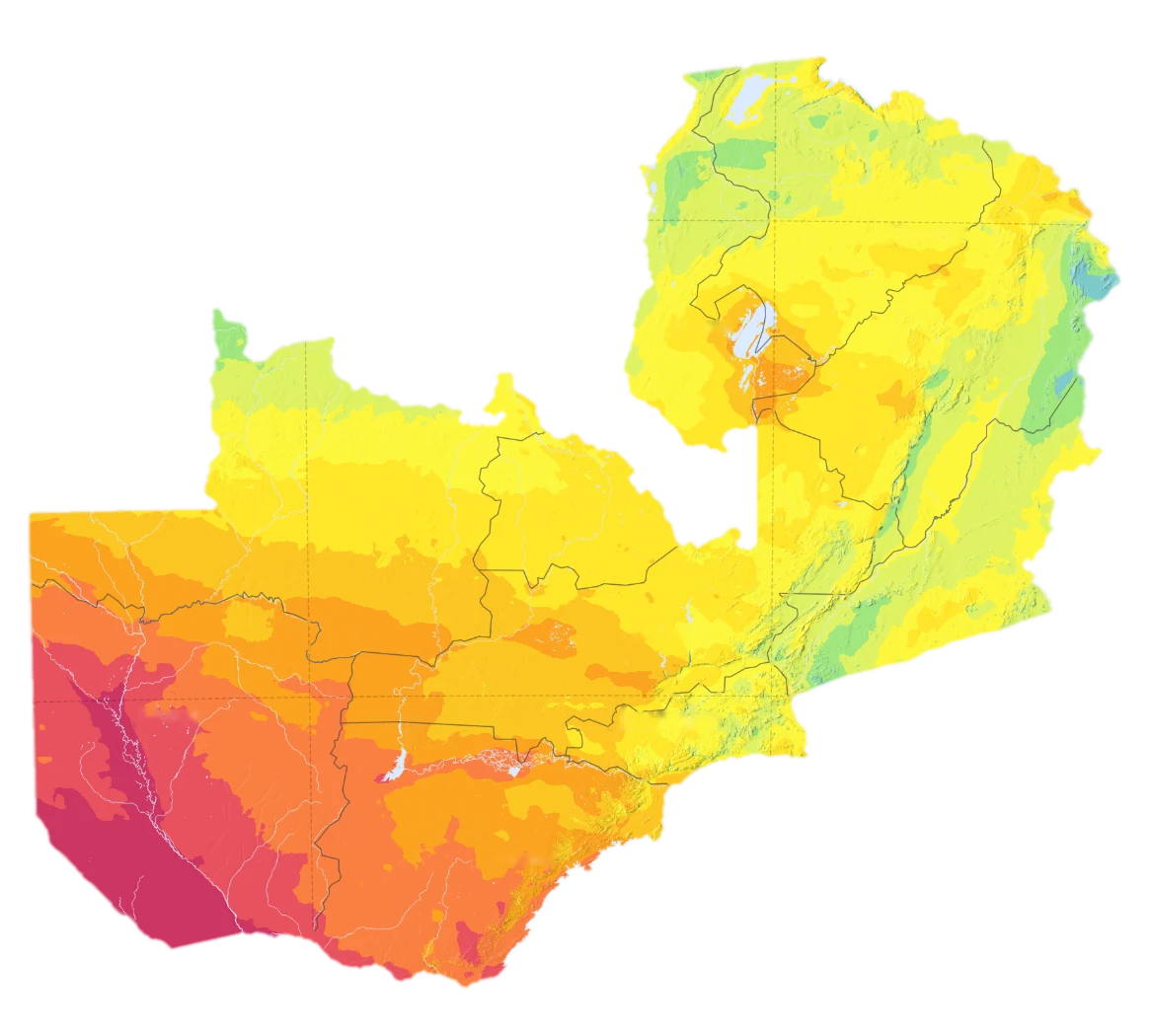
Long-term average of DNI (direct normal irradiation), 1994–2017
kWh per m². World Bank Group / ESMAP Solar Resource Atlas of Zambia, prepared by Solargis (2019). World Bank colour scale.
| Month | kWh/kWp/day |
|---|---|
| Jan | 4.32 |
| Feb | 4.57 |
| Mar | 4.97 |
| Apr | 5.08 |
| May | 5.14 |
| Jun | 4.93 |
| Jul | 5.03 |
| Aug | 5.48 |
| Sep | 5.54 |
| Oct | 5.46 |
| Nov | 4.86 |
| Dec | 4.52 |
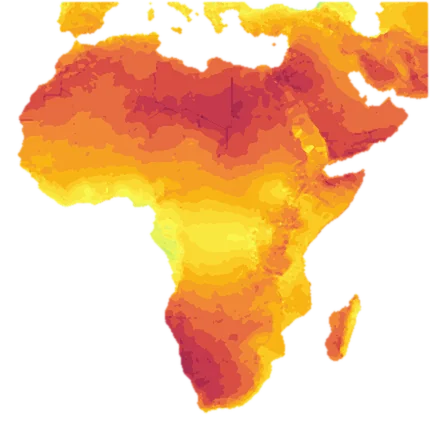
Zambia lies on the northern reaches of the Kalahari Basin. While the arid core of the Kalahari Desert is centred further south in Botswana, Namibia and South Africa, the vast geological basin extends northward across western Zambia and into parts of Angola and Zimbabwe, placing the country within one of the strongest solar resource regions on the continent. Irradiation is highest in the west: around Mongu, direct normal irradiation exceeds 2,100 kWh/m² a year. Rain is concentrated in a single wet season, which leaves a long, clear dry season, with peak solar output as hydropower reservoirs draw down.
Grid context: ZESCO's distribution network spans about 23,700 km at 11 kV, 8,900 km at 33 kV and 3,800 km at 66 kV across every province. Chiyaba will connect to the ZESCO 88 kV network at Gota Gota substation through dedicated evacuation infrastructure funded by Mpishi Energy under the Implementation Agreement, with Phase 1 export matched to current substation capacity.
Solar data: Solargis, Solar Resource and PV Potential of Zambia: Solar Resource Atlas (World Bank / ESMAP, 2019) and Global Solar Atlas 2.x (World Bank Group, ESMAP, Solargis; long-term averages to 2025), CC BY 4.0. Chiyaba site figures: PVsyst P50 yield simulation by Soventix GmbH (October 2025) using Solargis weather data; DNI from Global Solar Atlas point data for the site. Original World Bank colour scale retained; basemap labels removed for clarity. Network lengths: ZESCO Limited.
We take projects through the full development cycle ourselves (land, grid, environment, offtake and structuring), so that what reaches a lender's desk has already answered the questions a credit committee asks.
Resource, grid and demand screening before any land is touched. Only sites that pass all three move forward.
Environmental and social assessment to IFC Performance Standards, alongside the Zambian regulatory sequence.
Ring-fenced SPV, sculpted senior debt, reserve accounts and political-risk cover modelled before the first term sheet.
We contract tier-one EPC and OEM partners on fixed-price, date-certain terms with liquidated damages that match the PPA.
Our environmental and social management system is aligned to the IFC Performance Standards and structured for Equator Principles review, so development-finance institutions and commercial lenders can run their due diligence against a framework they already know.
Project-level ESMS, risk register, monitoring plan and grievance mechanism in place from development.
Local hiring targets, contractor codes of conduct and worker grievance channels written into EPC contracts.
Water-free module cleaning options, battery end-of-life plans and emissions-avoided accounting using the UNFCCC-approved grid emission factor for the Southern African Power Pool.
Traffic, construction and electrical-safety management plans, with community liaison officers on site during construction.
Sites selected to avoid physical displacement; freehold acquisition with documented, willing-seller consent.
Baseline ecological surveys inform layout. Chiyaba lies within the Chiawa Game Management Area; a DNPW site assessment found no threat to wildlife.
Screening and, where triggered, informed consultation and participation, or free, prior and informed consent, documented in the ESIA.
Chance-find procedures and heritage surveys embedded in construction method statements.
Alignment is self-assessed against the 2012 IFC Performance Standards and verified by independent E&S consultants at lender due diligence. Mpishi Energy does not claim certification by IFC.
Utility-scale power in Zambia is built with government, regulators and long-term capital at the table. These are the institutions we work with through licensing, authorisation and investment.





Names and logos belong to their owners. Listing reflects our regulatory and investment engagement and does not imply endorsement.
A founder-led Zambian company with the finance, technical, communications and coordination leadership to take Chiyaba through financial close and construction, supported by specialist advisers.
Leads the company and its relationships with government, regulators, offtakers and communities. Responsible for strategy, project delivery and the Board.
Leads investment, partnerships and capital raising across the platform. Background in renewable energy project development and finance, with governance, risk and information-security credentials.
Leads financial close, lender reporting, treasury and audit across the project companies.
Leads engineering, grid connection and EPC oversight, taking Chiyaba through construction and commissioning.
Leads investor, stakeholder and public communications, and the company's brand and disclosures.
Coordinates schedules, documentation and workstreams across permitting, finance and delivery.
Manages equipment import, customs clearance and site logistics.
Leads site origination, feasibility, permitting and land, taking projects from concept to financial close.
Construction oversight, O&M contracting and plant performance.
Advises on carbon revenue, crediting pathways and climate-finance structuring.
Supports financial modelling, investor analysis and transaction preparation.
Advises on ESG performance, plant optimisation and sustainability reporting.
Zambia's grid runs on water. Our job is to give it a second source that peaks when the reservoirs are lowest.Mpishi Energy, on why solar and storage, and why now
Senior lenders, DFIs, institutional equity and strategic co-developers: the Project Information Memorandum, financial model and document room are available under NDA.